
Absinthe has more myth attached to it than any other spirit, and most of the myth is wrong. It does not make you hallucinate. It was never banned in Australia in the way people assume. And the ritual that surrounds it is not theatre, it genuinely changes what is in the glass.
This guide answers the practical questions: what the law actually says here, what you need, how to pour it properly, and what to buy first.
Is absinthe legal in Australia?
Yes. Absinthe is legal to buy, sell and drink in Australia, and it is sold through licensed retailers in the normal way.
The confusion comes from two places. The first is that absinthe was banned across much of Europe and the United States between 1906 and 1915, and those bans lasted, in some cases, until the 1990s and 2000s. The second is that Australia does regulate one specific ingredient.
Under the Australia New Zealand Food Standards Code, wormwood and its derivatives are restricted, and absinthe may be imported and sold subject to limits on thujone, the compound in grande wormwood that the old scare stories were built around. Commercially produced absinthe sold through licensed Australian retailers is compliant with those limits. What you cannot do is import unregulated high-thujone product for sale, and you should be careful with anything bought informally from overseas.
In practice: buying absinthe from an Australian licensed retailer is entirely legal and entirely normal.
Does absinthe make you hallucinate?
No. This is the most persistent myth in spirits and it has been thoroughly examined.
The claim was that thujone caused madness and hallucinations. Modern analysis of surviving pre-ban bottles has repeatedly found thujone at levels far too low to produce any such effect, and well within the limits modern regulation allows.
What absinthe actually is, is very strong alcohol. Traditional bottlings sit between 45 and 72 per cent. In the late nineteenth century it was drunk in quantity, daily, by people who were also drinking a great deal of everything else. The effects attributed to the wormwood were the effects of the alcohol.
The ban itself owed more to politics than pharmacology. A wine industry devastated by phylloxera had every commercial reason to support a temperance campaign against the drink that had replaced wine, and one widely publicised murder case in Switzerland gave the campaign its moment.
What you need
You can drink absinthe with nothing but a glass and a jug of iced water. But the traditional kit exists for a reason, and each piece does a job.
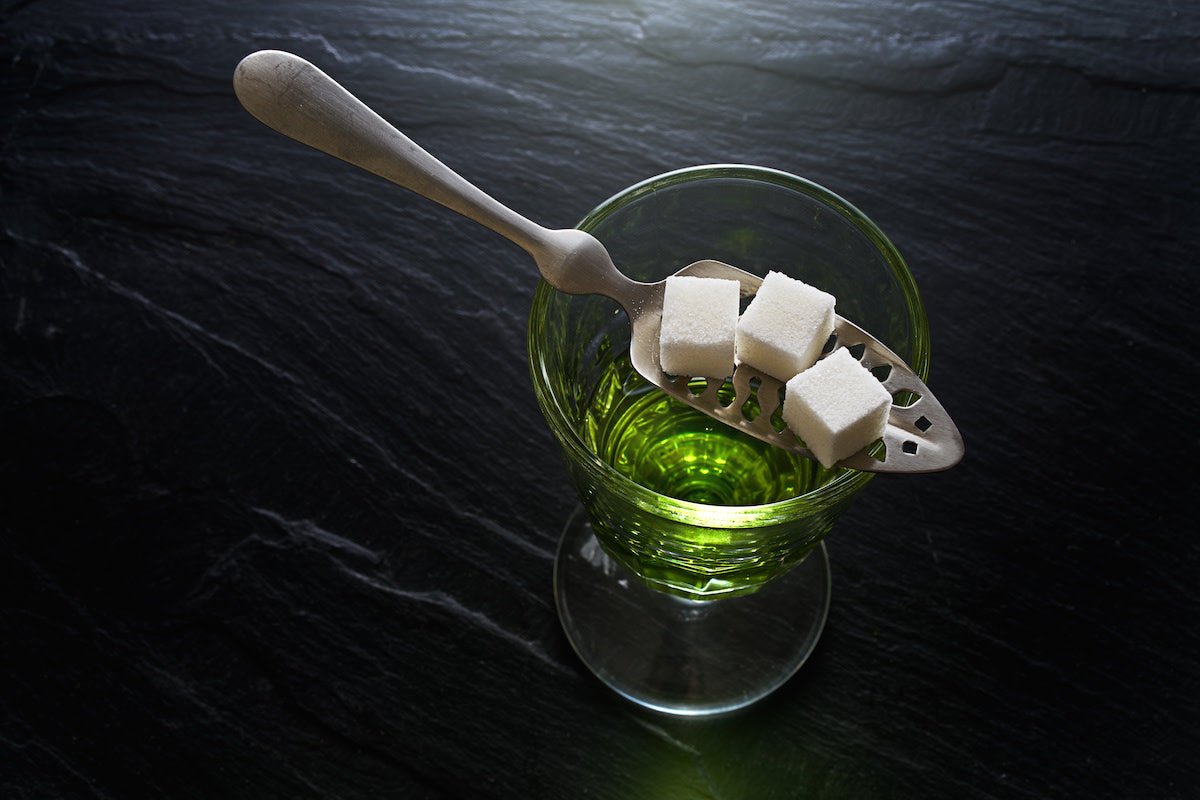
A glass. A proper absinthe glass has a reservoir at the base that marks the correct measure, so you pour by eye rather than by jigger. The Emile Pernot glass is the traditional Pontarlier shape.
A slotted spoon. Rests across the rim and holds the sugar while water drips through it.
A fountain. This is the piece that actually matters most. A fountain releases water one slow drip at a time, which is the difference between a proper louche and a cloudy mess. Ours come in two and four pourer versions, so more than one person can pour at once.
Sugar. Optional, and depends on the bottle. A wormwood-forward Pontarlier absinthe takes it well. A sweeter anise-led style usually does not need it.
The louche, step by step
The louche is the moment the drink turns from clear green to opaque, and it is the whole point of the ritual.
Pour roughly 30ml of absinthe into the glass, to the top of the reservoir if your glass has one.
Rest the slotted spoon across the rim and place a sugar cube on it, if you are using sugar.
Begin dripping iced water over the sugar, slowly. Watch the glass rather than the water: you will see the louche form in trails as it falls.
Keep going until you reach three to five parts water to one part absinthe. Three is strong, five is gentle. Stop when the colour stops changing.
Stir once, if the sugar has not fully dissolved.
What is happening is chemistry, not decoration. Anethole and the other essential oils from the anise and fennel are soluble in alcohol but not in water. As the water goes in, those oils come out of solution and suspend in the liquid, which is what makes it cloudy and what releases the aroma. Rush the water and they crash out all at once, which is why the drip matters.
Absinthe without a fountain
A carafe or a jug with ice in it works. Pour in a thin stream, as slowly as you can manage, and rest your hand on the rim to steady it.
A cheaper trick that works well: put iced water in a squeeze bottle with a fine nozzle. It is not traditional and nobody will be impressed, but it produces a proper louche.
What does not work is adding the water all at once, and what definitely does not work is ice first. Ice chills the absinthe before the oils have come out of solution and you get a thin, muted drink.
Never set it on fire
The burning sugar cube is a 1990s invention from the Czech Republic, created to make a low quality product look interesting. It has no basis in tradition, it burns off the aromatics you paid for, and it is a genuine fire risk with a spirit at 65 per cent.
Verte, blanche, and what the colour tells you
Verte is green, and the colour comes from a second maceration of herbs after distillation, usually including petite wormwood and hyssop. A natural verte fades towards amber with age, which is a sign of authenticity rather than a fault.
Blanche, sometimes called la bleue, skips that step and stays clear. It is often lighter and more anise-forward.
An aggressively neon green absinthe is coloured artificially, and it is a reasonable signal about what else has been done to it.
Where it comes from, and why Pontarlier matters
Absinthe began as a medicinal tonic in the Val-de-Travers, on the Swiss side of the Jura, in the late eighteenth century. Production crossed the border to Pontarlier in France, which by the late nineteenth century was the centre of world absinthe manufacture.
That is why Pontarlier still means something on a label. Distillerie Les Fils d'Emile Pernot distils there, and our range includes five of their expressions: the Authentique at 65 per cent, Berthe de Joux, Cousin Jeune, Deniset Jeune and Bourgeois, which are built around different balances of grande wormwood and anise.
Alongside them the absinthe range carries La Fee, Lemercier and the Provencal bottlings from Distilleries et Domaines de Provence.
Absinthe in cocktails
Absinthe is a seasoning as much as a base spirit. Quantities are small.
A Sazerac uses it as a rinse: a few millilitres swirled around a chilled glass and discarded before the rye goes in.
A Corpse Reviver No.2 takes a rinse or a single dash.
Death in the Afternoon, attributed to Hemingway, is absinthe topped with champagne. It is stronger than it sounds.
A bar spoon will also lift a Bloody Mary or an Improved Whiskey Cocktail more than you would expect.
Absinthe, pastis and ouzo
All three louche and all three taste of anise, but they are not the same drink.
Absinthe is distilled with its botanicals, contains grande wormwood, is not sweetened, and sits at 45 to 72 per cent.
Pastis was created after the absinthe ban. It is usually macerated rather than distilled, leans on liquorice root as well as anise, is sweetened, and sits at around 45 per cent. Our pastis range covers Henri Bardouin and Jean Boyer.
Ouzo is Greek, sweeter still, and typically lower in strength.
If you find absinthe too intense, pastis is the gentler way into the same flavour family.
What to buy first
If you have never had absinthe, start with something in the 55 to 65 per cent range from a producer with a real address rather than a brand name. A Pontarlier bottling is the safest bet.
Buy the glass and the spoon at the same time. They cost very little relative to the bottle and the drink is materially better with them.
The fountain is a genuine upgrade rather than an ornament, and it is what turns absinthe from a curiosity into something you actually pour on a Friday.
Browse the absinthe range to start, or the liqueurs range if you are building a bar around it.