
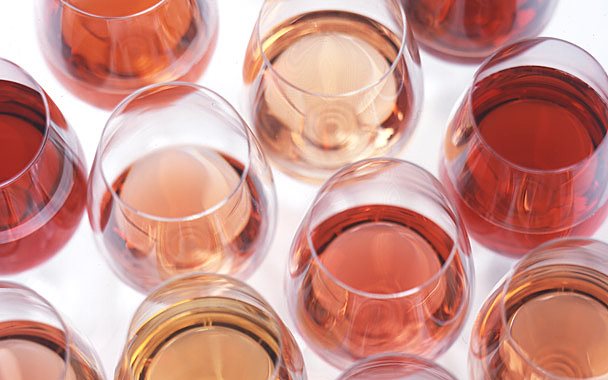
Standing in front of a wall of pink bottles is a genuinely difficult place to make a decision. Rosé is the only wine category named after a colour, and the colour is close to useless as a guide. Two bottles that look identical on the shelf can come from different countries, different grapes and completely different intentions.
This guide covers what actually separates one rosé from another, then narrows it down to a short list you can act on. Every wine named here sits in our rosé wine collection.
Rosé is a colour, not a style
Almost all red grapes have clear or near clear juice. Colour lives in the skins. So every rosé is really an answer to one question: how much contact does the juice get with the skins, and how is it separated from them? There are three common approaches.
- Direct pressing. Fruit goes to the press straight away and the juice is run off with very limited skin contact.
- Short maceration. The juice is held on skins for a set number of hours before pressing. Chateau Barthes states that its Bandol rosé is hand harvested and macerated on skins for 24 hours at 10 degrees.
- Saignée. A portion of juice is drawn off a red ferment early and finished separately. The Italian name for the same technique is salasso.
None of these is inherently better. They are different tools, and a producer chooses one based on the fruit and the wine they want at the end of it.
Does paler mean drier?
This is the shortcut almost everyone uses, and it is not reliable. Colour depth is a function of grape variety, skin contact and method. Sweetness is a function of how much sugar is left after fermentation. The two are not linked, and a bottle rarely tells you directly which end of the scale it sits at.
Price will not tell you either. What genuinely narrows it down is knowing the region, its rules and the grapes behind the wine, which is where the rest of this guide goes.
Bandol: the structured end
Bandol is its own appellation. It is worth being precise about that, because Bandol is often loosely lumped in with pink wine from elsewhere in the south of France, and its rules are considerably tighter. The AOC covers eight communes in the Var: Bandol, Le Beausset, La Cadière-d'Azur, Le Castellet, Évenos, Ollioules, Sanary-sur-Mer and Saint-Cyr-sur-Mer.
The rules that matter most for rosé, taken from the appellation's own specification, are these. The principal varieties are cinsaut, grenache and mourvèdre. Mourvèdre must sit between 20 and 95 per cent of the blend. Accessory varieties, meaning bourboulenc, carignan, clairette, syrah and ugni blanc, are capped at 10 per cent each and 20 per cent combined. Harvesting is by hand, and bunches must be transported whole to the winery.
A compulsory floor of a late ripening, firm variety plus compulsory hand picking is why Bandol rosé is treated as a serious wine in its own right rather than a warm weather afterthought. Bandol is well represented in the range.
- Chateau Barthes Bandol Rose 2023. The producer gives the blend as equal parts cinsaut, grenache and mourvèdre, hand harvested and macerated on skins for 24 hours at 10 degrees.
- Domaine du Gros Noré Bandol Rosé 2024, with the 2023 vintage also listed. The domaine is at La Cadière-d'Azur, one of the eight communes. For the 2023, the stated blend is 50 per cent mourvèdre with 25 per cent each of grenache and cinsault, hand harvested and macerated on skins for 24 hours at 10 degrees, which puts it well clear of the appellation's mourvèdre floor. Bandol blends vary between producers and between vintages, and no breakdown is published for the 2024, so take that one on its own terms rather than assuming it repeats the 2023.
AOP and IGP are not the same claim
One more French distinction is worth carrying with you. An AOP such as Bandol binds a producer to specific varieties, yields, harvesting methods and a small defined area. An IGP covers a much larger zone with looser requirements. The Chateau Roubine R de Roubine is an IGP Méditerranée wine from Lorgues, so it is not making an appellation claim and should not be measured against one. Neither designation is a quality ranking by itself. They tell you how tightly the wine is constrained, which is a different and more useful piece of information.
Rioja rosado: the middle ground
Spain calls it rosado. Rioja is looser than Bandol on what goes into the blend and stricter on the vocabulary used to describe ageing.
Under the DOCa Rioja specification, a rosado must use a minimum of 25 per cent of the red varieties Tempranillo, Garnacha Tinta, Graciano, Mazuelo and Maturana Tinta. That is a floor rather than a target, and plenty of producers work well above it. The permitted white varieties include Viura, Malvasía, Garnacha Blanca, Tempranillo Blanco, Maturana Blanca, Turruntés, Chardonnay, Sauvignon Blanc and Verdejo.
Rioja's ageing terms apply to rosado as well as red, which catches people out. For white and rosé wines, Crianza requires 18 months total in barrel and bottle with a minimum of six months in oak. Reserva requires 24 months total with at least six in oak. Gran Reserva requires 48 months total, again with a minimum of six months in oak. If a rosado carries none of those words, it is a young wine, which for most rosé is exactly the intention.
Muga Rosado 2024 is the Rioja in the range. Bodegas Muga sits in the Barrio de la Estación in Haro, in the Rioja Alta subzone, and the winery was founded in 1932.
Australia: read the region
For an Australian rosé, the single most useful thing on the front label is the region. Australian geographical indications are held on the Register of Protected Geographical Indications and Other Terms, kept by Wine Australia under the Wine Australia Act 2013. Wine Australia's Label Integrity Program requires that more than 85 per cent of the grapes come from a stated vintage, variety or GI for that claim to appear on the label.
That makes a regional name a real piece of information about where the fruit grew, not decoration. Several Australian regions are represented below.
- Margaret River, Western Australia. Woodlands Watson Family Rose 2023. Woodlands states the wine is made from low cropping shiraz with 11 per cent cabernet franc, crushed and then pressed off to stainless steel for a slow, cool fermentation, and bottled early.
- Mornington Peninsula, Victoria. Port Phillip Salasso Rose 2023. Despite the name, this has no connection whatsoever to Portuguese fortified wine. Port Phillip is the bay the Mornington Peninsula wraps around.
- Barossa Valley, South Australia. Tomfoolery Trouble and Strife Cabernet Franc Rose, made from cabernet franc. We have written separately about Tomfoolery Wines.
- Canberra District. Nick O'Leary Rose, from cool climate fruit in the Canberra region. This is a good illustration of why the register is worth reading: the Canberra District GI sits in the Southern New South Wales zone but falls partly in New South Wales and partly in the ACT, so the regional name, not the state, is the precise claim. The producer describes its estate as sitting in the Hall Valley, just outside the ACT.
What to check before you order rosé online
Buying rosé without the bottle in front of you is actually easier than buying it in a shop, provided you read the right four things.
- The vintage. Most rosé is made to be drunk young, and vintages turn over quickly. Confirm the year on the listing is the one you want, and note where a listing tells you the vintage may vary.
- The region, not just the country. "French rosé" is not information. Bandol, IGP Méditerranée, Rioja, Margaret River and Barossa Valley all are, because each one carries a set of rules behind it.
- The composition, where the producer states it. Knowing a wine is built on mourvèdre, or on shiraz with a cabernet franc component, tells you far more than the shade of pink in the bottle.
- What you are actually opening it for. A wine with a firm, structured backbone behaves differently at the table from a light, direct pressed one. Match the wine to the meal you are planning rather than to a picture of a bottle.
The shortlist
Small and deliberately so. Every one of these has a real region and a real set of rules behind it.
- Chateau Barthes Bandol Rose 2023, AOC Bandol, France.
- Domaine du Gros Noré Bandol Rosé 2024, La Cadière-d'Azur, AOC Bandol.
- Muga Rosado 2024, Haro, DOCa Rioja.
- Woodlands Watson Family Rose 2023, Margaret River.
- Port Phillip Salasso Rose 2023, Mornington Peninsula.
- Tomfoolery Trouble and Strife Cabernet Franc Rose, Barossa Valley.
- Nick O'Leary Rose, Canberra District.
- Chateau Roubine R de Roubine, IGP Méditerranée, Lorgues.
The full range, including anything that has landed since this was written, sits in the rosé wine collection. If you want one wine to start with and you want to understand why Bandol gets talked about the way it does, start with the Chateau Barthes and work outward from there.