
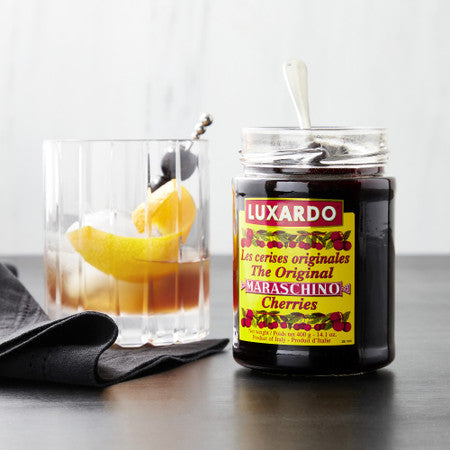
There are two very different things sold as maraschino cherries. One is the bright red, candied cherry from a supermarket jar. The other is the dark, almost black cherry that Luxardo has made in Italy for generations. This guide explains the difference, how Luxardo makes its cherries, how to use them in drinks and desserts, and how they connect to Luxardo's Maraschino liqueur.
Quick picks
- Luxardo Maraschino Cherries 400g jar: the home bar size.
- Luxardo Maraschino Cherries 1000g tin: for regular cocktail makers and home baking.
- Luxardo Maraschino Originale: the cherry liqueur made from the same marasca cherry.
Two kinds of maraschino cherry
The bright red kind follows an old American definition. The US Food and Drug Administration's compliance guidance regards "maraschino cherries" as the common name for cherries that "have been dyed red, impregnated with sugar and packed in a sugar sirup flavored with oil of bitter almonds or a similar flavor". That is the cherry most people picture on top of a sundae.
Luxardo's cherries are a different product. Luxardo describes them as "candied cherries soaked in Luxardo marasca cherry syrup". It states that no thickening agents and no preservatives are used, and that the dark red colour "is all natural". The jars and tins are roughly half cherries and half syrup.
The result is a darker cherry with real sour cherry flavour, which is why it suits a stirred whiskey drink.
The marasca cherry
The marasca is a sour cherry. Until the 1700s, according to Luxardo, almost all marasca production was concentrated near Almissa, south of Split in Dalmatia. Girolamo Luxardo founded the distillery in Zara, now Zadar, in 1821.
After the Second World War destroyed Zara and disrupted the Dalmatian supply, the company was rebuilt in 1947 in Torreglia, near Padua in north-eastern Italy, beneath the Euganean Hills. Luxardo then expanded marasca growing in Italy. Its own variety, the Marasca Luxardo, was selected by Giorgio Luxardo with Professor Morettini of the University of Florence, and is smaller and juicier than the traditional marasca. Luxardo grows it in modern orchards across north-eastern Italy under company supervision, and the company is still controlled by the founding family.
How Luxardo makes its cherries
Ripe marasca cherries are dark purple, tending to black. Luxardo candies them and soaks them in a syrup made from marasca cherry juice, the same juice it uses for the infusion of its Sangue Morlacco cherry liqueur. That syrup is where the flavour comes from.
Luxardo says its candying process gives the fruit a crispness, and that it uses a pasteurisation system for preservation.
Using them in drinks
Both of these International Bartenders Association recipes finish with a cocktail cherry, and this is where a Luxardo cherry earns its place.
Manhattan. Stir 50 ml rye whiskey, 20 ml sweet red vermouth and 1 dash of Angostura bitters with ice, strain into a chilled cocktail glass and drop in one cherry. A spicy rye such as Willett Family Rye 4 years Small Batch stands up well to the dark fruit.
Old Fashioned. Saturate a sugar cube with Angostura bitters in an old fashioned glass, add a few dashes of plain water and muddle until dissolved. Add ice and 45 ml bourbon or rye, stir gently, and garnish with an orange slice or zest and a cherry.
Keep the syrup. Luxardo suggests using it in cocktails as a flavoured sugar, so a barspoon of it in place of the sugar cube gives an Old Fashioned a gentle cherry note.
For more cocktail ideas suited to warm weather, see Christmas cocktails for an Australian summer, and for the Angostura side of things, Bitters Explained.
Using them in desserts
Luxardo suggests the cherries over ice cream, and they work just as well on sundaes and in baking. Spoon a few cherries and a little syrup over vanilla ice cream, fold them through a cake batter, or use them to finish a chocolate dessert. The syrup can be drizzled straight from the jar.
The Maraschino liqueur link
The name maraschino comes from the marasca cherry, and Luxardo uses the same fruit for Luxardo Maraschino Originale, a clear cherry liqueur and a separate product from the cherries in the jar. Luxardo infuses its marasca cherries for up to three years with leaves and branches from the same trees, distils both the liquid and solid parts in copper pot stills, and ages only the heart of the distillate in ash wood vats. It is bottled at 32% in a tall green bottle hand-plaited in straw within the company.
Two classic IBA recipes put the liqueur and the cherries together:
- Aviation: shake 45 ml gin, 15 ml Luxardo maraschino liqueur, 15 ml fresh lemon juice and 1 bar spoon crème de violette with cracked ice, strain into a chilled cocktail glass, and garnish with a maraschino cherry if you like.
- Last Word: shake equal parts (22.5 ml each) gin, green Chartreuse, Luxardo maraschino and fresh lime juice with ice, and strain into a chilled cocktail glass.
For more on the liqueur shelf, see Types of Liqueur Explained.
Which size to buy
- 400g jar: suits a home bar.
- 1000g tin: for frequent cocktail makers, entertaining and baking.
- 5.6kg tin: the catering size for bars and restaurants.
Luxardo makes more than cherries and Maraschino. Luxardo Amaretto di Saschira takes its almond character from apricot and cherry kernels as well as almonds, and works over ice or in an Amaretto Sour.
Where to start
- For your first jar: Luxardo Maraschino Cherries 400g.
- For a Manhattan: the cherries plus Willett Family Rye 4 years Small Batch.
- For an Aviation or Last Word: Luxardo Maraschino Originale.
- For a busy bar or kitchen: the 1000g tin or 5.6kg tin.
- Browse the full Luxardo range, our cocktail enhancers and liqueurs.
We deliver to every Australian state and the ACT.