
Japanese whisky, under the industry labelling standard that took full effect in April 2024, is whisky mashed, fermented, distilled, aged for at least three years and bottled in Japan. Japan also produces a wide range of blended whiskies, aged, finished and blended there by long established houses, and these are some of the most approachable bottles in the category.
This guide explains what the term means, how to read a bottle, how whisky is served in Japan, and which of the bottles in our Japanese whisky collection suits which drinker.
What does "Japanese whisky" mean on a label?
Until 2021 there was no agreed definition. On 12 February 2021 the Japan Spirits & Liqueurs Makers Association (JSLMA) set its Standards for Labeling Japanese Whisky. Under them, "Japanese whisky" (or "Japanese whiskey") may only be used when:
- Ingredients are limited to malted grains, other cereal grains and water extracted in Japan, and malted grain must always be used.
- Mashing, fermentation and distillation all take place at a distillery in Japan, with the spirit distilled to less than 95% alcohol.
- Ageing happens in wooden casks of 700 litres or less, in Japan, for at least three years.
- Bottling happens only in Japan, at no less than 40% alcohol. Plain caramel colouring is allowed.
The standard applied from 1 April 2021, with a transition period to 31 March 2024 for products already on sale, which is why April 2024 is when it took full effect. For whisky that does not meet the requirements, it also restricts Japanese place names, the Japanese flag and similar cues on the label, unless the label makes clear the product does not meet the standard.
The standard is voluntary and set by an industry body, not by law. In March 2025 the JSLMA said it is working to make the definition legally binding, introduced a "JW" logo that members can use on qualifying bottles and said it would prepare a geographical indication application. In March 2026, Japan's National Tax Agency told the Diet, Japan's parliament, that it is working with industry groups on a legal definition, with no date set.
Japanese whisky and Japanese blended whisky
In practice you will meet two broad kinds of bottle from Japan. One is Japanese whisky made entirely in Japan under the standard. The other is blended whisky that a Japanese producer ages, finishes or blends in Japan, sometimes including whisky distilled elsewhere, a style often called a world blend. Both can make a very good glass, and the second is where most of the creative cask work on our shelf happens.
All seven bottles we currently stock are blends. Rather than read anything into the label, here is what each producer says about how its whisky is made.
Togouchi
Togouchi comes from SAKURAO Brewery and Distillery in Hatsukaichi, Hiroshima, founded in 1918 as Chugoku Jozo and since renamed. It opened Sakurao Distillery on the Seto Inland Sea in 2017. The company matures whisky in two places: at the distillery, and inside a tunnel on a disused railway section at Togouchi in Akiota town, which gives the brand its name.
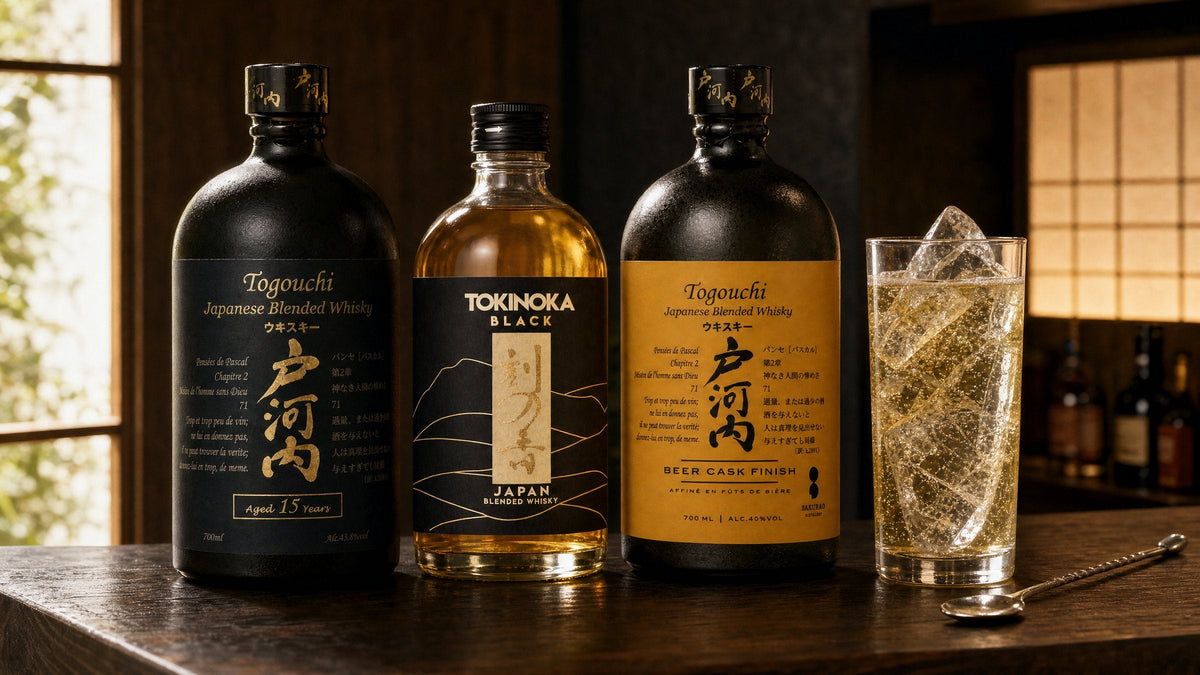
In Japan, the company relaunched its blends in September 2023 as "Blended Japanese Whisky Togouchi", made only from malt and grain whisky distilled and stored at Sakurao, and states that they meet the standard. Recipes and labels can differ between the Japanese domestic range and bottlings sold overseas, so we describe our Togouchi bottles by what is confirmed for them: Japanese blends with tunnel ageing and some unusual cask finishes. Togouchi 15 Years, for example, brings together malt and grain whiskies of different origins, including Scotland, and the producer says it is aged and blended in Japan. Our earlier article on Togouchi and its tunnel covers the brand's background.
Yamazakura
Yamazakura is made by Sasanokawa Shuzo of Koriyama, Fukushima, a sake house founded in 1765 that received its whisky licence in 1946 and began distilling at its own Asaka Distillery in March 2016. The company notes on its Yamazakura blends that they combine whisky from Asaka with imported whisky, so the skill here is in the blending. Yamazakura Blend is the house blend built for the highball.
Tokinoka
Tokinoka is made by Eigashima Shuzo, whose White Oak Distillery is in Akashi, Hyogo. Eigashima was founded in 1888, released its first White Oak whisky in 1919 when its distillery plant was completed, and built its current whisky distillery in 1984. It is a JSLMA member and states that it complies with the labelling standard. Tokinoka is the house blend of malt and grain whisky, and Tokinoka Black is a richer version from master blender Akito Ueda.
What does Japanese whisky taste like?
There is no single Japanese flavour, but the blends on our shelf lean towards balance, and several are made with long drinks in mind. Three styles stand out.

- Light, balanced blends. Malt and grain whisky married for softness. Tokinoka shows cereal, honey and vanilla, while Yamazakura Blend leans floral, with orange blossom and orchard fruit.
- Cask finishes. Togouchi finishes whisky in casks that held something else, including sake from the company's own brewery and IPA beer, which adds a second layer of flavour to a gentle base.
- Richer, stronger blends. Tokinoka Black raises the malt to half the recipe and the strength to 50%, for a rounder, spicier glass.
How do Japanese people drink whisky?
Japan's distillers take long drinks seriously. Nikka's own serving guide includes the highball, whisky topped with soda over plenty of ice, and whisky with cold water, known in Japan as mizuwari. Both reward a careful build.

The Japanese highball
This follows the method Nikka publishes, at its standard ratio of one part whisky to three parts soda.
- Fill a tall tumbler to the brim with ice.
- Add 30 ml of whisky and stir about ten times to chill the whisky and the glass.
- Pour 90 ml of well chilled soda water slowly, keeping it off the ice so it holds its fizz.
- Lift the ice once gently with a bar spoon and stop. Nikka advises against vigorous stirring.
Adjust the ratio to taste. A strip of lemon peel is optional.
Mizuwari
Use a smaller tumbler than for a highball. Add ice and 30 ml of whisky, stir about ten times, then add 60 to 75 ml of cold mineral water, which is Nikka's two to two and a half parts water to one of whisky. Stir well and let it rest for about 20 seconds before drinking.
Neat or twice up
For a bottle you want to taste properly, such as Togouchi 15 or Tokinoka Black, try it neat first. Then try what Nikka calls "twice up": equal parts whisky and room temperature water, no ice, in a small tasting glass.
Which Japanese whisky to buy
Here is who each of the seven suits.
- Yamazakura Blend: for the highball drinker. It is light and floral by design and comes in a 500 ml bottle, an approachable starting point if you mostly mix.
- Tokinoka Blended: for anyone who wants something soft and balanced, with cereal, honey and vanilla and a malty, creamy finish.
- Tokinoka Black: for the drinker who finds standard blends too gentle. Half malt, matured in bourbon, sherry and new oak casks, bottled at 50%, with tropical fruit and toasted oak.
- Togouchi Premium: for a classic, no age statement blend of malt and grain with a subtle peated note, and the natural first bottle for getting to know the Togouchi house style.
- Togouchi Sake Cask Finish: for the sake fan. Aged in bourbon casks, then finished for three months in sake casks from the Sakurao brewery, giving brown sugar sweetness against gentle acidity.
- Togouchi Beer Cask Finish: for the craft beer drinker. The casks held Martinique rum, then IPA in France, before this blend, so expect hops, honey and baked apple. Try it with salty snacks.
- Togouchi 15 Years: for the sipper or a gift. The oldest bottle here, at 43.8%, with citrus and yellow fruit, vanilla, a fine thread of peat and a dark chocolate and hazelnut finish.
The Togouchi bottles also sit together in our Togouchi collection. If you are buying for a Japanese food lover, our guide to sake and Japanese gift bottles has more ideas.
Japanese whisky FAQ
Is Japanese whisky good?
Japan has a long record with whisky: construction of Suntory's Yamazaki, the country's oldest malt whisky distillery, began in 1923. Newer producers keep adding to it: Sakurao launched its Sakurao and Togouchi single malts in 2021. As with Scotch, quality comes down to the bottle, so read the label to see how the whisky was made, then choose on flavour.
Why is Japanese whisky expensive or hard to find?
Demand grew faster than stocks of aged whisky. In 2018 Suntory discontinued Hakushu 12 and Hibiki 17, citing supply constraints. Whisky takes years to mature, and newer distilleries such as Asaka (2016) and Sakurao (2017) have only recently had stock old enough to bottle.
Is it Japanese whisky or whiskey?
Both spellings appear, and the JSLMA standard treats "Japanese whisky" and "Japanese whiskey" the same way. The producers in this guide use "whisky". The spelling tells you nothing about quality or where the whisky was made.
What is the best Japanese whisky for a highball?
A light, balanced blend at 40%. Yamazakura Blend is made with the highball in mind, and Tokinoka Blended is another soft, balanced option. For a highball with more character, try Togouchi Beer Cask Finish.
Find your bottle
Start with how you like to drink: a crisp highball, a long mizuwari or a slow glass of Togouchi 15. Then pick the style that suits. Browse our full Japanese whisky range. We deliver to every Australian state and the ACT.