
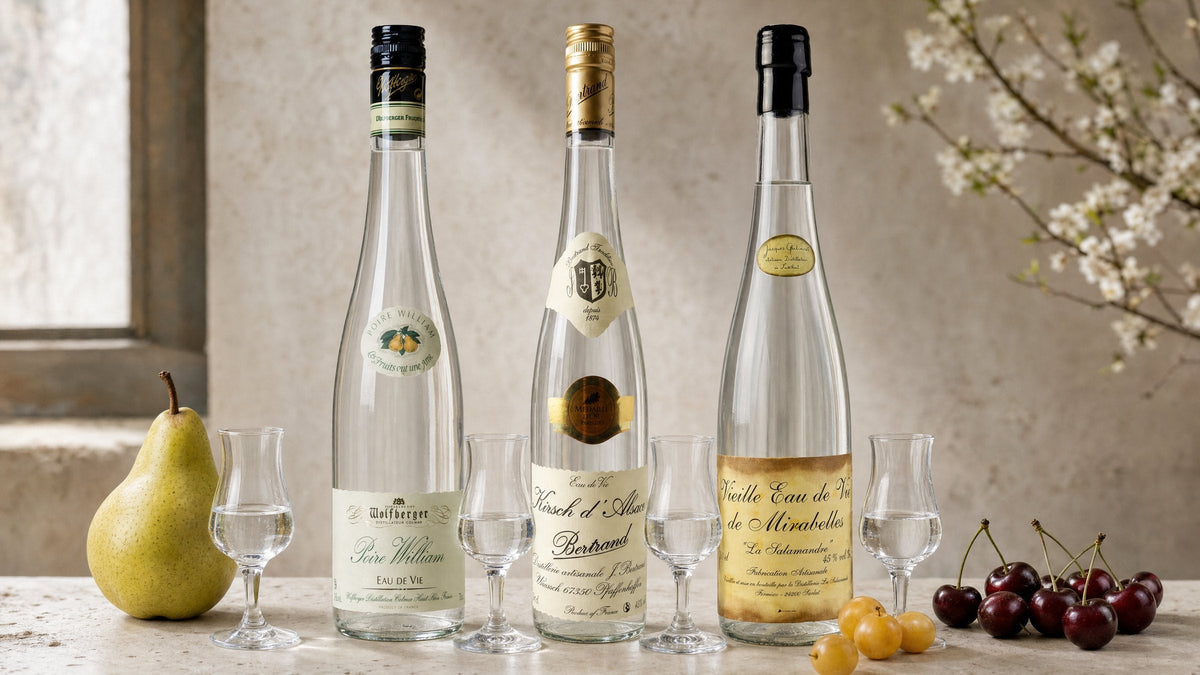
Eau de vie is a clear spirit distilled from fruit, most often fermented Williams pears, cherries or plums, and usually bottled without time in wood so it tastes vividly of the fruit it came from. The French name means "water of life", and in English these spirits are often called fruit brandies, although under EU rules they are a separate category from brandy, which is made from wine.
There is little or no sugar, no colour and no flavouring added: just the pear, cherry or plum, concentrated by the still. Here is how it is made, how it differs from brandy, schnapps and liqueur, and which bottles from our eau de vie collection to start with.
What does eau de vie mean?
Eau de vie (plural eaux de vie) is French for "water of life", a translation of the Medieval Latin aqua vitae. Merriam-Webster defines it as "a clear brandy distilled from the fermented juice of fruit (such as pears or raspberries)". In practice the term covers a family of spirits made from fruit and berries, and in Alsace even from roots and flowers.
How eau de vie is made: fermentation, maceration and Geist
The EU spirit drinks regulation (Regulation 2019/787) is the clearest guide, because it splits these spirits into distinct legal categories.
Fruit spirit: fermented, then distilled
A "fruit spirit" is made only by fermenting fresh, fleshy fruit (or its must) and distilling it, with or without the stones. Every distillation must be below 86% ABV so the spirit keeps the aroma and taste of the fruit, no alcohol may be added, it cannot be flavoured, and it must be bottled at 37.5% ABV or more. This is the classic route for pears, cherries and plums, which have enough natural sugar to ferment. The rules also set some names: "kirsch" means cherry spirit, "quetsch" is a plum spirit, "mirabelle" is spirit of the mirabelle plum, and "Williams" may only be used for pear spirit made solely from Williams pears.
La Salamandre's Poire William is fermented naturally, run through copper stills keeping only the heart, then rested for at least two years in vats. Rochelt in Tyrol mashes its pears immediately at harvest before distilling.
Maceration and distillation: for low-sugar fruit
Some fruit does not carry enough sugar to ferment into a worthwhile spirit. Raspberry is the classic example: La Salamandre says its raspberries have too little sugar to ferment on their own, so it steeps them in eau de vie and then distils the lot. The EU calls this a "spirit obtained by maceration and distillation". The fruit, partially fermented or unfermented, is steeped with no more than 20 litres of added alcohol per 100 kg of fruit, then distilled below 86%, and bottles must carry the words "obtained by maceration and distillation" on the front label. The permitted list includes raspberry, blackberry, sloe, holly berry, rosehip, elderberry, citrus, banana and walnut.
Distillerie Metté in Ribeauvillé, Alsace, uses both routes: naturally sweet fruit is fermented, while berries, flowers and spices are macerated in wine eau de vie, then distilled in small copper stills.
Geist and gentian
A Geist (German for "spirit") goes further: unfermented fruit, herbs, flowers or other plant material are steeped in neutral agricultural alcohol, then distilled. Gentian has its own category again: a spirit distilled from fermented gentian roots. Wolfberger's Eau de Vie Gentiane is made from the root of this yellow mountain flower, and the house describes a woody nose with fresh, earthy notes.
Eau de vie vs brandy vs schnapps vs liqueur
- Eau de vie (fruit spirit): distilled from fruit, at least 37.5% ABV, usually unaged and clear, with no more than 18 grams of sweetening per litre.
- Brandy: under EU law, "brandy" is made from wine spirit and must age at least six months in oak casks under 1,000 litres, or a year in larger oak. Our guide to brandy covers it in depth, and Calvados shows what happens when apple spirit is aged in oak.
- Schnapps: in Germany, Schnaps simply means strong spirit. Traditional fruit schnapps is a close cousin of eau de vie, while the sweet "peach schnapps" style is an American liqueur with little in common with it, as The Oxford Companion to Spirits and Cocktails notes.
- Liqueur: sweetened and often flavoured, with a minimum of 15% ABV and generally at least 100 grams of sugar per litre. See our types of liqueur guide.
Why eau de vie is clear (and the aged exceptions)
Eau de vie is clear because spirit comes off the still colourless, and producers who want to keep it that way rest it in something that adds nothing, such as stainless steel or glass. Metté ages its eaux de vie in stainless steel vats kept outdoors, and keeps 30 litre glass demijohns for its older spirits. Rochelt matures its fruit brandies in open glass balloons; its Wild Plum from Piedmont spends at least eight years in glass. EU rules say fruit spirit must not be coloured, with one exception: caramel may adjust the colour of a fruit spirit that has been aged at least a year in contact with wood.

Some bottles do see wood on purpose. La Salamandre Vieille Prune d'Ente is the Sarlat distillery's house classic: Ente plums rested for many years in old oak barrels, which give it an amber colour and a rounder texture. Bertrand Prune Vieille also rests in oak, and Bertrand Mirabelle shows a very pale amber tint that the house puts down to ageing. Bertrand's special reserve spirits go into small ash barrels instead, a white wood the distillery says keeps the character of the eau de vie intact.
Types of eau de vie: from Williams pear to holly berry
Williams pear (Poire Williams)
Juicy, perfumed and instantly recognisable on the nose. Our pear bottles come from Alsace, south-west France and Austria.
Kirsch
Cherry spirit, often made with the stones left in. Wolfberger describes a stony, kernel-like bouquet in its kirsch, and Bertrand calls its own kirsch, made from small black large-stoned cherries, its most celebrated eau de vie.
Mirabelle and quetsch
Two plums. Mirabelle is the small golden plum of Lorraine; quetsch is the purple plum of Alsace, which Bertrand says gives an unusually complex spirit with mint and aniseed notes.
Framboise
Raspberry, often made by maceration for the reasons above. Bertrand describes its wild raspberry spirit as very fresh, with concentrated, long raspberry aromas.
Unusual botanicals
This is where Alsace gets adventurous: gentian root, holly berry, rosehip, sloe, elderflower, sweet woodruff, mullein and meadowsweet. Wolfberger Églantine is a rosehip spirit (the French nickname for rosehip is gratte-cul) with a soft floral perfume and jam-like palate, and Domaine du Bollenberg's Fleurs de Molène turns mullein flowers into a 50% spirit with exotic fruit and lychee notes.
How to drink eau de vie
Pour a small measure, around 30 ml, into a tulip glass or a small eau de vie glass, the two shapes Metté and La Salamandre suggest. Serving temperature divides producers, so check the label.

- Cool, not iced: La Salamandre suggests 10 to 12°C for its Poire William and Mirabelle. Metté recommends 13°C for its Williams Pear.
- Very cold: Bertrand chills the glass with ice before pouring its kirsch. Wolfberger suggests serving its kirsch ice-cold, and Bollenberg suggests about 3°C for its mullein flower spirit.
- Room temperature: La Salamandre serves its oak-aged Vieille Prune at 18 to 20°C and says chilling closes up the wood and prune notes.
A tip from La Salamandre: when the glass is empty, smell it. The fruit lingers.
Serve 1: the Rose cocktail
Harry McElhone's 1922 book Harry's ABC of Mixing Cocktails credits this drink to Johnny of the Chatham Hotel bar in Paris, and David Embury later wrote that it was very popular in Paris in the 1920s.
- 60 ml dry vermouth, such as Dolin Dry
- 30 ml kirsch
- 5 ml redcurrant syrup (Embury used raspberry syrup)
Stir with ice, strain into a chilled coupe and garnish with a cocktail cherry.
Serve 2: pear and soda
30 ml Williams pear eau de vie in a tall glass over ice, topped with 120 ml chilled soda water and a thin slice of pear. Light, dry and very fragrant.
Serve 3: with sorbet
Wolfberger suggests pouring its Églantine over a scoop of sorbet; 15 ml is plenty. Its Poire William also suits a scoop of pear sorbet or vanilla ice cream served alongside.
Which eau de vie to buy: where to start
- Wolfberger Poire William: a classic Alsace pear and a straightforward first bottle.
- La Salamandre Poire William: never touches wood, for drinkers who want the purest pear flavour.
- Metté Williams Pear: double distilled and textured, for those who like a juicy, grainy pear character.
- Rochelt Williams Pear 2015: a vintage-dated Austrian pear at 50%, for the collector or a special gift.
- Bertrand Kirsch: concentrated cherry with a light nutty edge, for the Rose cocktail or sipping.
- Wolfberger Kirsch: a powerful, stony cherry spirit for desserts and cocktails.
- La Salamandre Mirabelle: Lorraine mirabelles with almond notes, for plum lovers.
- Bertrand Quetsch: fresh and herbal, for drinkers who like complexity.
- Bertrand Framboise Sauvage: wild raspberry with real finesse, a good cocktail base.
- Bertrand Baies de Houx: a special reserve holly berry spirit aged in ash, for the curious.
- Wolfberger Gentiane: woody and earthy, for fans of bitter, savoury flavours.
- La Salamandre Vieille Prune d'Ente: an amber, oak-aged plum for brandy drinkers moving across.
If you like these, you may also enjoy grappa, another clear spirit built around its raw material.
Eau de vie FAQ
How do they get the pear in the bottle?
The bottle is fixed over a young pear on the tree in spring, and the fruit grows inside it. Once ripe, the pear is picked with its bottle, cleaned and the bottle is filled with pear eau de vie. The French call it poire prisonnière. None of the bottles we currently stock has one, but the spirit inside is the same Williams pear style described above.
Is kirsch an eau de vie?
Yes. Under EU rules, kirsch is a legal name for spirit made from cherries, so it is a cherry eau de vie.
Is eau de vie the same as fruit brandy?
In everyday English, yes, and producers such as Rochelt describe their spirits as fruit brandy. Under EU rules, though, "brandy" on its own means an oak-aged spirit made from wine.
Should eau de vie be served from the freezer?
None of our producers mentions the freezer. Bertrand, Wolfberger and Bollenberg favour very cold serves for some spirits, while La Salamandre asks for its unaged spirits cool but never iced, and its aged plum at room temperature. Follow the label, or start cool and taste.
How strong is eau de vie?
Fruit spirit must be at least 37.5% ABV under EU law. Most bottles in our range sit between 40% and 50%.
Ready to explore? Browse our full eau de vie range, from Alsace pear to Rochelt's vintage plum. We deliver to every Australian state and the ACT.