
An aperitif is a drink poured before a meal, usually lighter, drier or more bitter than what comes after. The name comes from the Latin aperire, to open: traditionally it is the drink that opens the evening, while a digestif is the one that closes it.
In practice "aperitif" covers a whole shelf of bottles: French quinquinas, gentian aperitifs, Italian bitter reds, vermouth, fruit wines, dry sherry and, these days, some very good alcohol-free options. This guide sorts them by family and by taste, gives you three easy serves, and points you to the bottles worth starting with. Browse the full range in our aperitifs collection.
Aperitif vs digestif: what's the difference?
The difference is timing and style. An aperitif comes before food and tends to be lower in alcohol, often wine based, and built around a bitter, citrus or lightly sweet profile. A digestif comes after the meal and is usually richer or stronger: think cognac, calvados, grappa or a dark amaro such as Fernet-Branca, which is traditionally served neat and cold after dinner.
The idea is a ritual, not a rule. Plenty of bottles cross over, and the French word apéro now means the whole occasion: a drink, a few olives or some saucisson, and friends before dinner.
What defines an aperitif?
There is no single legal category called "aperitif". What most of these bottles share is a base and a bittering agent.
- The base. Many French aperitifs are aromatised wines or are built on mistelle, which is grape juice fortified with alcohol so it stops fermenting and keeps its natural sugar. Under EU rules, an aromatised wine must be at least 75% wine products and sit between 14.5% and just under 22% alcohol.
- The bitterness. Two plants do most of the work. Cinchona bark (quinquina, the source of quinine) gives the "quina" and "kina" styles. Gentian root, a wild mountain plant, gives the earthy, citrusy bitterness of the gentian aperitifs. The EU recognises both: a "quinquina wine" is flavoured mainly with natural quinine, and a "bitter vino" mainly with natural gentian.
- The rest. Citrus peel, herbs, spices and fruit round things out. Vermouth is the aromatised wine defined by wormwood (Artemisia).
Types of aperitif, with examples
If you searched for an "aperitifs list" or "aperitif examples", this is it, family by family.

Quinquinas and kina
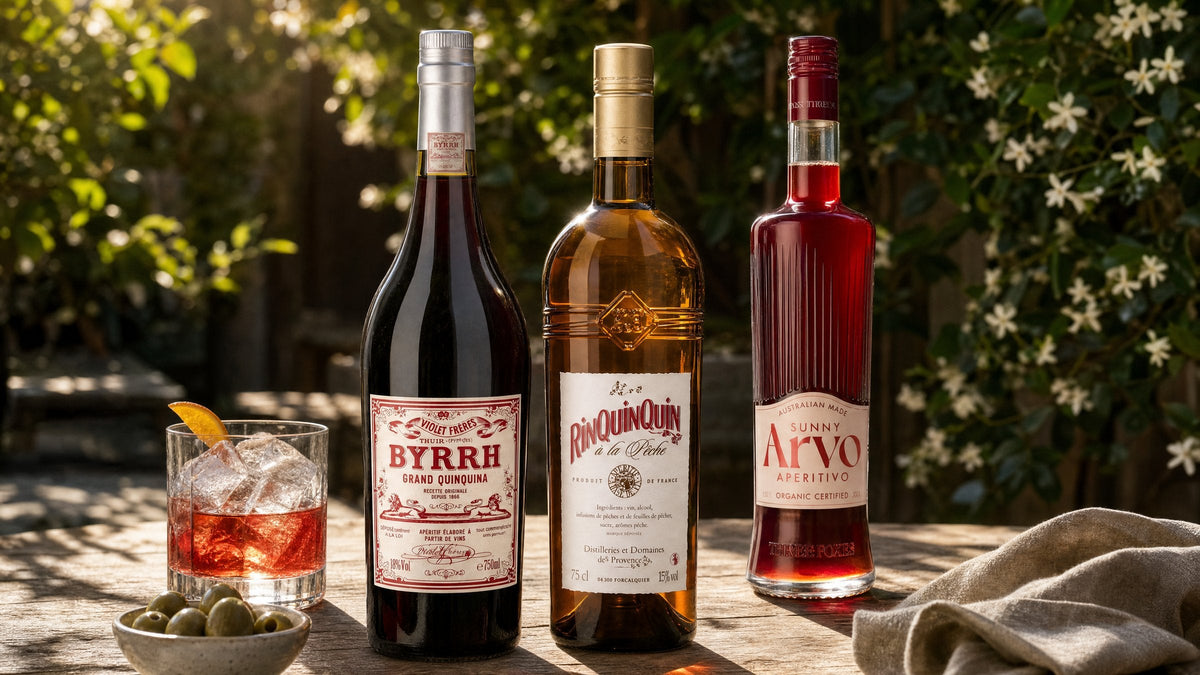
Wine or mistelle with cinchona bark: fruity, winey and finished with a gentle grip of bitterness. Byrrh comes from Thuir, in Roussillon, where the Violet brothers, Simon and Pallade, set up their business in 1866; the Byrrh name followed in the 1870s, and it is still made in Thuir today. Wine and mistelle give it a rich, almost port-like body, with natural quinine providing the bitter backbone. St Raphaël makes two Quinas on a mistelle base with quinquina, bitter orange, vanilla and cocoa: the Red is powerful and winey, the Amber softer, with caramel and vanilla. Maurin Quina, first made in Le Puy-en-Velay in 1884 and famous for Cappiello's 1906 green devil poster, adds wild cherry to its cinchona and white wine. Closer to home, White Possum Kina takes the kina idea in an Australian direction: Mt Macedon sauvignon blanc, fortified and infused with orange peel, cinnamon myrtle, strawberry gum and earthy herbs.
Gentian aperitifs
Gentian is earthier and more bracing than quinine, with a citrus edge. Salers has been made since 1885 from the root of yellow gentian (Gentiana lutea) gathered in Auvergne, and is rested in Limousin oak for more than three years. Gentiane de Lure from Distilleries et Domaines de Provence is a gentler, wine-based take, one of the house's oldest recipes, with sweet and bitter orange peel lifting the root. Bonal combines both bitters. It was created in 1865 using plants from around the Chartreuse mountains and was later bought by Dolin, the vermouth house of Chambéry in Savoie. Gentian, cinchona and orange go into a mistelle base.
Bitter red aperitivo
The Italian branch: bright red, bittersweet and made for spritzes and Negronis. Distilleria Negroni Bitter is a 20-day infusion of citrus peel, rhubarb, gentian, liquorice and quassia, with gentian leading the bitterness. Bordiga Bitter Rosso is a citrusy, gently sweet red bitter made to an original recipe that recalls the 1950s. Reid + Reid from New Zealand brings manuka and kawakawa to gentian and hibiscus. Two Australian makers are worth a look: Three Foxes Sunny Arvo Aperitivo, an organic aperitivo from Heidelberg West with citrus, rosella and lemon myrtle, and Autonomy Davo Plum, with Davidson plum, rosella and orange, built for an Aussie spritz. For deeper bitter liqueurs and amaro, see our guide to bitters, bitter liqueurs and amaro.
Vermouth
Vermouth is a classic aperitif in its own right and deserves its own shelf: dry, blanc and rosso styles, over ice or in a Martini or Negroni. Explore it in our vermouth collection.
Fruit and fortified wine aperitifs
French country aperitifs are at their most varied here. Distilleries et Domaines de Provence makes RinQuinQuin à la Pêche from peaches, autumn peach leaves and white wine, and Orange Colombo from rosé wine with bitter and sweet orange and cinchona. Vedrenne's Terres Rouges house offers a sun-dried Figue and a Vin de Noix, green walnuts steeped in wine and aged in oak. La Salamandre's Le Poirier blends its own Williams pear brandy with sweet wine. Several of these sit in our mistelles collection alongside Pineau and Pommeau.
Sherry and Dubonnet
A chilled dry fino such as Don Zoilo Fino is one of the classic Spanish aperitifs; our sherry styles guide explains the range. Dubonnet Rouge, a quinine-edged red aperitif wine dating to 1846, is best known for the Gin Dubonnet.
Non-alcoholic aperitifs
Gambetta, a Provençal brand its maker dates to 1870, macerates fruits, plants and barks: the Bitter works as a zero-proof red bitter, and the Tradition leans to citrus, caramel and liquorice. Three Foxes Nopertivo is a wine-styled, alcohol-free aperitivo with rosella, clove, grapefruit and blood orange, finished with a bitter kick.
How to choose an aperitif by taste
If you like bitter
Start with Salers or Distilleria Negroni Bitter. Bonal and Gentiane de Lure are a step softer, with the bitterness wrapped in wine.
If you like sweet and fruity flavours
Choose RinQuinQuin for ripe peach, Le Poirier for pear, the Vedrenne Figue for fig, or St Raphaël Amber for cocoa and vanilla. All are wine strength rather than spirit strength, so they suit a long, relaxed pre-dinner glass.
If you usually drink wine
Go for the wine-based styles: Byrrh and Maurin Quina if you like reds, Orange Colombo if you drink rosé, and Gentiane de Lure if you drink whites. They will taste familiar, with an extra layer of citrus and bitterness.
If you like it dry
A well chilled fino sherry is the driest choice here: Don Zoilo Fino has less than one gram of sugar per litre. Among the French bottles, the gentian aperitifs keep the focus on bitterness; try Salers over ice with a squeeze of lemon.
How to drink an aperitif: three simple serves
Serve aperitifs cold. Most wine-based bottles should go in the fridge once open.

- Over ice with soda. Pour 60ml of aperitif over plenty of ice, top with 60 to 90ml of soda water and add a strip of orange peel. Good with Maurin Quina, Reid + Reid or Maidenii Roselle Bitter.
- The spritz. Three Foxes' own Sunny Arvo Spritz is 60ml Sunny Arvo Aperitivo and 90ml prosecco in a wine glass with a slice of orange; add ice if you like it colder. For something livelier, the Spicy Orange Spritz from Distilleries et Domaines de Provence combines 60ml Orange Colombo, 60ml fresh orange juice, 6 to 8 mint leaves and a teaspoon of chilli powder with 90 to 120ml prosecco and 30 to 60ml soda, garnished with a mint sprig and an orange wheel.
- Aperitif and tonic. The house Salers Tonic is 40ml Salers and 100ml tonic built over ice, stirred and finished with a strip of orange zest. Three Foxes does the same with Sunny Arvo: 60ml and 90ml tonic in a wine glass with a slice of orange.
If you would rather skip the mixers, the producer of RinQuinQuin recommends it neat and chilled, with an ice cube or two. For an alcohol-free version, Maison Janot's Gambetta Limonade is 20ml Gambetta topped with 100ml craft lemonade and a dash of lemon juice.
Which aperitif to buy: where to start
- Byrrh: for red wine drinkers who want a fruity quinquina to sip over ice.
- Dolin Bonal: for the curious, gentian and quinine together in one balanced bottle.
- Salers: for committed bitter fans and anyone who likes a G&T but wants something earthier.
- Gentiane de Lure: an approachable starting point for gentian, softened by white wine and orange.
- RinQuinQuin à la Pêche: for those with a sweet tooth who want a light, peachy pre-dinner glass.
- Orange Colombo: for rosé drinkers and spritz lovers.
- La Salamandre Le Poirier: for pear lovers, and handy for desserts too.
- Vedrenne Figue: for the deep, round flavour of sun-dried fig, served well chilled.
- Maurin Quina: for cherry lovers who still want a bitter finish.
- Distilleria Negroni Bitter: for spritz and Negroni makers who want a gentian-forward red.
- Three Foxes Sunny Arvo Aperitivo: for a local, organic spritz base with native botanicals.
- Three Foxes Nopertivo: for anyone skipping alcohol who still wants a proper bitter aperitivo.
Aperitif FAQ
What is a good French aperitif?
For a classic French experience, try a quinquina such as Byrrh or St Raphaël, a gentian aperitif such as Salers or Bonal, or a Provençal fruit wine such as RinQuinQuin. Serve them chilled, neat or over ice.
Is an aperitif the same as an aperitivo?
Aperitivo is the Italian word for the same pre-dinner drink and ritual. In English it usually refers to the bittersweet red Italian style, such as Distilleria Negroni Bitter or Bordiga Bitter Rosso.
Is vermouth an aperitif?
Yes. Vermouth is an aromatised wine flavoured with wormwood and is one of the classic aperitifs, served on its own over ice or in cocktails.
Do aperitifs need to be refrigerated after opening?
Wine-based aperitifs should be kept in the fridge once open. Vedrenne recommends keeping its Figue and Vin de Noix chilled before and after opening, and RinQuinQuin keeps for several months when kept cold.
Ready to set up your own apéro hour? Browse our full aperitifs range. We deliver to every Australian state and the ACT.