
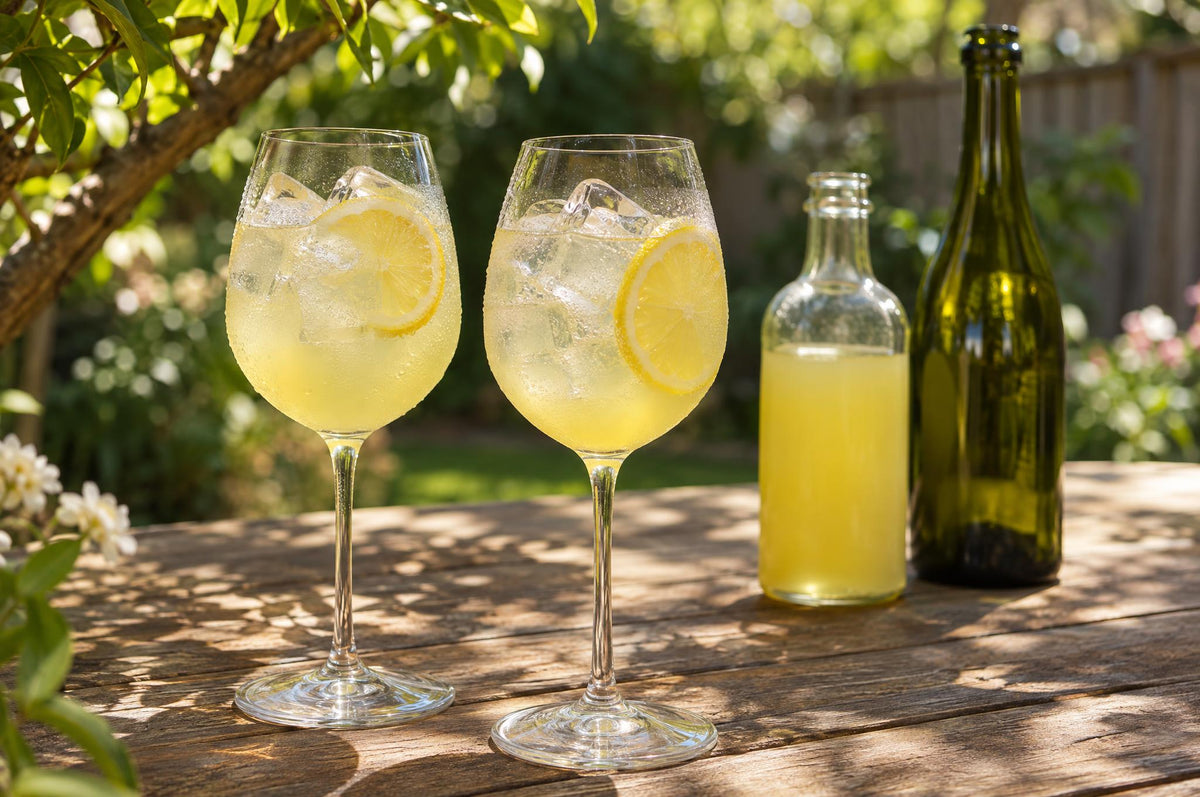
A classic limoncello spritz recipe is 60 ml limoncello, 90 ml prosecco and a splash of soda, built over ice in a wine glass with a slice of lemon. That ratio suits a 20 per cent limoncello. Stronger bottles need less: 50 ml at 25 per cent, 45 ml at 27 to 28, and 35 ml at 35.
Quick picks
- Vedrenne Limoncello at 25 per cent: from a Burgundy house that has macerated fruit since 1923, and our pick for a first spritz.
- Three Foxes Sunny Arvo Limoncello at 20 per cent: the Australian bottle, made with organic lemons and a hint of lemon myrtle.
- Autonomy Bitter Limoncello at 25 per cent: for anyone who finds a standard limoncello spritz too sweet.
A standard drink in Australia is 10 g of pure alcohol. The figures below are our own arithmetic from label strengths, so check the bottle in front of you. For how limoncello is made and where it comes from, see Limoncello Explained.

What is in a limoncello spritz?
Limoncello, sparkling wine, soda water, plenty of ice and a slice of lemon. Two published recipes agree on the core. Three Foxes gives 60 ml of its Sunny Arvo Limoncello to 90 ml prosecco with a slice of lemon. Olive magazine uses the same 60 and 90 with a splash of sparkling water, thyme and a lemon slice, and names no strength for the limoncello.
Our build for one glass, using a 20 per cent limoncello:
- 60 ml limoncello, well chilled
- 90 ml prosecco, well chilled
- 30 ml soda water
- a slice of lemon
Fill a large wine glass with ice. Pour the limoncello, then the prosecco, then the soda, and stir once so the bubbles survive. Add the lemon last. That glass is about 1.7 standard drinks. The 60 and 90 belong to Three Foxes and Olive. The 30 ml of soda is ours.
What is the best ratio for a limoncello spritz?
The right ratio depends on the bottle, and this is the part most recipes skip. The limoncello strengths we could confirm in our range run from 20 to 35 per cent, so 60 ml of a 35 per cent bottle holds 75 per cent more alcohol than 60 ml of a 20 per cent one. Pour the same measure and you get a different drink.
So we scale the pour to the label. Each row below gives about 12 ml of pure alcohol from the limoncello, the same as the Three Foxes measure, with 90 ml prosecco at 11 per cent and 30 ml soda. This is our own table, worked out from label strengths. It is not a producer's recipe, so taste the first glass and adjust.
| Limoncello | Strength | Pour per glass | Standard drinks | What it brings |
|---|---|---|---|---|
| Three Foxes Sunny Arvo | 20% | 60 ml | 1.7 | Organic lemon with a hint of lemon myrtle |
| Vedrenne | 25% | 50 ml | 1.8 | Lemon peel macerated in Burgundy |
| Autonomy Bitter | 25% | 50 ml | 1.8 | Lemon curd sweetness, then a bitter finish |
| Luxardo | 27% | 45 ml | 1.7 | Juicy and oily, from peel, pulp and juice |
| Distilleria Negroni | 28% | 45 ml | 1.8 | Fresh and bold, with a strong zest nose |
| Limonio | 35% | 35 ml | 1.7 | Intense lemon oil from Sicilian peel |
| Cello | Read the label | Use the nearest row | Read the label | Fresh local lemons and sugarcane alcohol |
| Canberra Distillery | Read the label | Use the nearest row | Read the label | Sweet and tart, made in the classic Italian style |
Around 20 per cent: pour 60 ml
At this strength the limoncello can take up a larger share of the glass, which is why Three Foxes' measure works. You get more lemon and more liqueur in the drink, so it reads rounder. If it tastes rich, add soda before you cut the limoncello.
25 to 28 per cent: pour 45 to 50 ml
This is where most Italian-style bottles sit, and it is the easiest band to get right. The wine has more room, so the prosecco's fruit comes through alongside the lemon.
35 per cent: pour 35 ml
At 35 per cent, Limonio is the strongest bottle here, so pour less. At the full 60 ml the glass climbs to about 2.4 standard drinks, so measure it with a jigger rather than by eye.
No producer strength: check the bottle
We could not confirm a strength from either producer for Cello or Canberra Distillery, and we will not guess one. Read it off the back label and use the nearest row.
Which limoncello is best for a spritz?
The one whose lemon you like, poured to its strength. Six places to start:

- Vedrenne, for a first spritz. Made at Nuits-Saint-Georges in Burgundy by a house that has worked with fruit since 1923. Vedrenne suits soda or sparkling wine, and 25 per cent is an easy strength to pour.
- Three Foxes Sunny Arvo, for an Australian bottle. Made by Three Foxes in Heidelberg West, Victoria, and the lowest strength of the bottles here. The 60 and 90 measure is the maker's own.
- Luxardo, for the familiar Italian name. Luxardo infuses peels, pulp and juice of lemons harvested in southern Italy, and first advertised its limoncello in 1905.
- Distilleria Negroni, for a cloudy Italian style. A natural infusion from the Treviso countryside, fresh and bold on the palate.
- Limonio, for lemon oil up front. Made from Femminello di Zagara Bianca peel grown at Partinico in Sicily. It also works as a splash in a spritz.
- Cello or Canberra Distillery, for more local choice. Both are Australian and both keep to the classic style.
Our guide to types of liqueur shows where limoncello sits on the wider shelf, and What Is an Aperitif covers the wider aperitif family.
Which prosecco should you use?
A cold one that does not add much sweetness of its own, because the limoncello already brings plenty. The label can mislead: in the Prosecco DOC consortium's list of styles, Brut is the drier one and Extra Dry the softer, despite the name.
- Lamberti Prosecco DOC Extra Dry is still our first pick, whatever the name suggests. It is light and fruit forward, made by the tank method, and at 11 per cent it is the wine our table is built on. The soda and lemon keep the glass in balance.
- Loredan Gasparini Prosecco comes from an old Glera plot on the Montello hillside, north of Venice, and gives you a more characterful base.
- Kientzler Crémant d'Alsace is the alternative when you want it drier. It is made by the traditional method and tastes dry and vinous, so it pulls the spritz away from sweetness.
More are in our Prosecco and Sparkling Wine ranges.
Why is my limoncello spritz too sweet?
Usually the pour is too big for the bottle. Three fixes, in order. Cut the limoncello by 10 ml and pour again. Add 30 ml more soda. Squeeze a wedge of fresh lemon into the glass. If it is still too sweet for you, switch to a drier sparkling wine or to Autonomy Bitter below.
How do you make a limoncello spritz for a crowd?
One 750 ml bottle of prosecco gives you eight glasses at our 90 ml measure. For Vedrenne at 25 per cent, that means:
- 400 ml limoncello
- 750 ml prosecco
- 240 ml soda water
- lemon slices
Chill everything first. Put the limoncello and lemon slices in a large jug, and add the prosecco and soda only when you are ready to pour, so the bubbles last. Keep the ice in the glasses, not the jug, or the last pour will be weaker and flatter than the first. Each glass is about 1.8 standard drinks, so pour to the measure and have water and food on the table. For a 20 per cent limoncello, use 480 ml instead of 400 ml.

What is a sgroppino?
A sgroppino is a lemon sorbet whisked with chilled vodka and prosecco, from Venice. Gambero Rosso traces it to Venetian tables, where it is traditionally served between courses or at the end of a meal, and quotes a New York Times recipe that also uses limoncello: about 85 g lemon sorbet, 15 ml vodka, 15 ml limoncello and 60 ml prosecco, finished with lemon zest.
Whisk it in a chilled bowl and pour into a flute, about 1.3 standard drinks with a 25 per cent limoncello, a 40 per cent vodka and an 11 per cent prosecco. Make each one to order, because the sorbet separates as it melts. For the vodka, Hartshorn Sheep Whey Vodka from Tasmania has a creamy texture that suits the sorbet.
Two variations worth trying
The bitter spritz. Autonomy Bitter Limoncello is made in Victoria from lemon peels left over after juicing by Market Juice in Melbourne, and it runs from lemon curd sweetness to a bitter end. Use the 25 per cent row: 50 ml with 90 ml prosecco and 30 ml soda, about 1.8 standard drinks. It sits between a limoncello spritz and an Italian bitter spritz.
Gincello and soda. 5Nines Gincello at 31 per cent blends limoncello with a lemon gin, and 5Nines suggests it with lemon tonic or soda and a lemon wheel. Our measure is 40 ml with 120 ml soda over ice, about 1.0 standard drink.
Three Foxes has a tonic version too, with rosemary, which you will find in our Australia Day cocktails. If you like this style of drink, our Hugo Spritz is the elderflower version, and summer cocktails has a longer list for hot weather. For sparkling drinks on 31 December, see New Year's Eve cocktails, and for the Christmas table, our Christmas cocktails.
Limoncello spritz FAQ
How strong is a limoncello spritz?
Built to our table, one glass is about 1.7 to 1.8 standard drinks, with more than half of the alcohol coming from the limoncello. A 35 per cent limoncello poured at the full 60 ml takes the same glass to about 2.4 standard drinks, which is why the measure should change with the bottle.
Should limoncello be cold before you make a spritz?
Yes. Keep the bottle in the fridge or freezer and chill the prosecco too. Our Vedrenne and Cello listings both suggest pouring straight from the freezer, and Three Foxes says to serve its limoncello chilled. Cold ingredients melt the ice more slowly, so the drink stays colder and less watery in the glass.
Do you need soda water in a limoncello spritz?
No. Three Foxes leaves it out and uses only limoncello, prosecco and lemon. Soda makes the drink longer and a little less sweet without adding any alcohol. We add 30 ml because it suits a hot afternoon, and it is the simplest fix if the first sip tastes too rich.
Can you use Champagne instead of prosecco?
You can, and you will get a drier drink with more bready notes than prosecco's fresh fruit. We would keep good Champagne for the glass and use a crémant instead, such as Kientzler, which is also made by the traditional method. At 12 per cent, allow a little more alcohol per glass.
Is a limoncello spritz the same as a canned one?
Not quite. A canned spritz is pre-mixed, so the maker has already chosen the limoncello, the wine, the strength and the sweetness. Making your own lets you set each of those and taste as you go. Check the standard drinks on the can, as you would on any bottle.
Where to start
- First limoncello spritz: Vedrenne Limoncello with Lamberti Prosecco.
- Australian bottle: Three Foxes Sunny Arvo Limoncello.
- Less sweet: Autonomy Bitter Limoncello with Kientzler Crémant d'Alsace.
A good limoncello spritz recipe is mostly a matter of matching the pour to the strength on the label. The full range is on our Liqueurs page, the wine is in Prosecco, and Limoncello Explained has the background. We deliver to every Australian state and the ACT.